
Read Sedgwick County Deed Types
Every deed moves an interest from a grantor to a grantee. The wording of the instrument controls what actually passed. Sedgwick County groups the main deed families under the DEED% search code. The code covers joint-tenancy, warranty, quitclaim, and transfer-on-death deeds. The same index holds mortgages, releases, tax liens, plats, oil-and-gas instruments, and powers of attorney touching real estate.
| Deed Type | What It Does | Common Use |
|---|---|---|
| Warranty deed | Conveys title with stated covenants | Ordinary sale transfer |
| Quitclaim deed | Transfers only the interest the grantor has | Interest cleanup or family transfer |
| Joint-tenancy deed | Places title in named joint tenants | Co-ownership with survivorship terms |
| Transfer-on-death deed | Names a beneficiary for a later transfer | Estate planning |
| Trustee or representative deed | Conveys through an authorized fiduciary | Trust or estate transaction |
A mortgage or lien is not a deed. It records an encumbrance, meaning a claim or charge against the property. A later release or satisfaction can clear that filing from the record. Check the document type and each party's role before adding anything to a title chain.
Sedgwick Deed Index Search Fields
The Register of Deeds online index opens behind a Kansas public-record acknowledgment. Its own advice is that less is more. A spare search using a party, a role, a document family, and a date often beats a fully filled form. People are indexed as LAST FIRST MI. Try a company name exactly as it was recorded.
| Field or Mode | Format | Local Search Detail |
|---|---|---|
| Document Number | Exact number | Opens the matching record result. |
| Film/Page | Number pair | Leading zeroes may be needed. |
| Document Type | DEED% | Searches deed families. |
| Name and Role | LAST FIRST MI; GTOR/GTEE | Separates giver from recipient. |
| Subdivision/Lot/Block | Selected addition and numbers | Reserves use codes such as RESA. |
| Section/Township/Range | Survey fields | Quarter-quarter boxes may produce bad results. |
Use MISC.RMTG for a mortgage release, and try MISC.SMTG for a satisfaction if nothing comes back. A blue document number opens the image. View Details shows the index data. Stay signed in until the whole search session is done.
Sedgwick Deed Coverage Cutoffs
Deeds are indexed online from 1945 to the present. Other instruments date from 1969, according to the county's Online Land Record Search page. Those are web cutoffs only. County deed records run much deeper. Permanent holdings start from a deed recorded in 1870. The recorder entry page lists the available channels and their coverage.
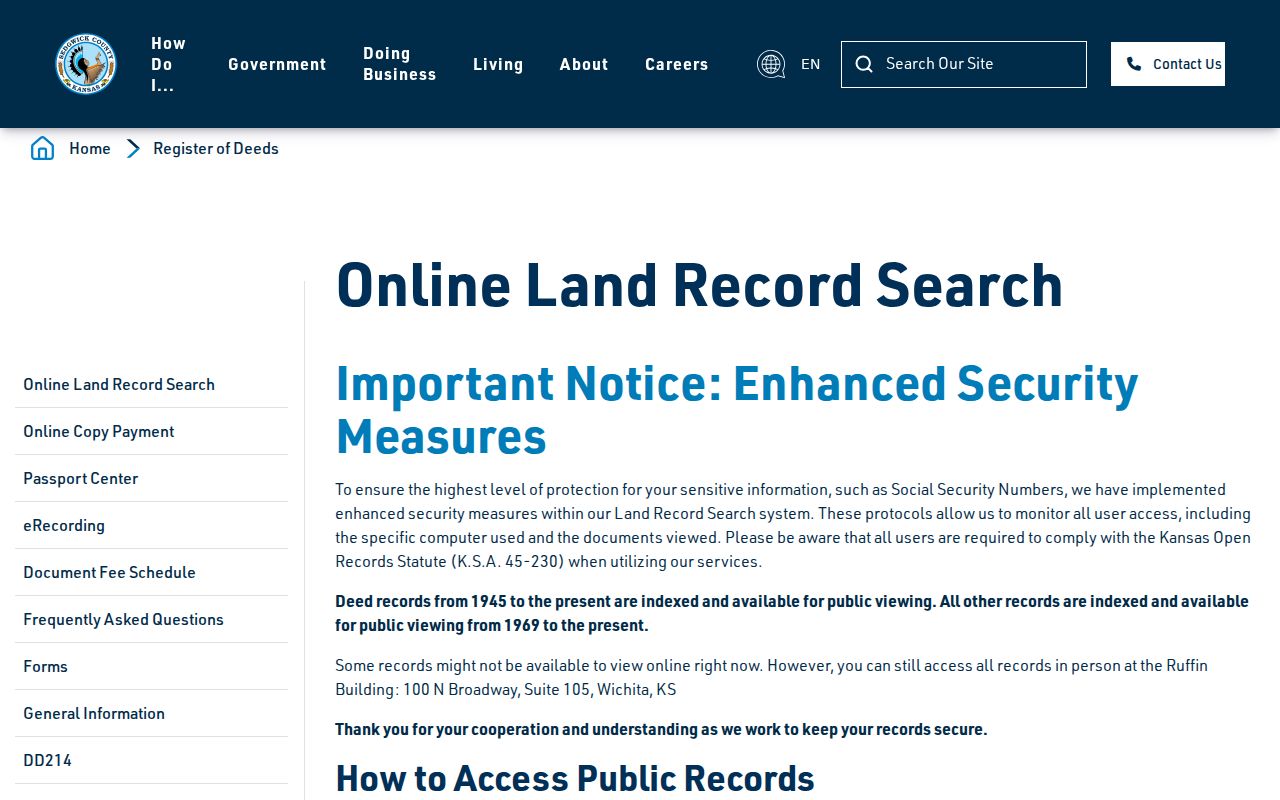
That entry page points to the free public system, paid remote products, and help with older records. For a deed predating online coverage, give staff the last transfer date, a party name, and an address or legal description. They can work through the old grantor and grantee books and find the film or book-and-page reference from there.
Trace Sedgwick Grantor to Grantee
A chain of title is the ordered set of transfers affecting one piece of land. Begin with the latest deed. Grabbing a random same-name result is how chains go wrong. The current appraisal record can suggest a likely owner of record and a legal description, but the recorded instrument remains the stronger evidence of the conveyance itself.
- Find the current owner's acquisition deed with that party listed as grantee.
- Read the legal description and recording reference, then note the grantor.
- Search that grantor as a grantee in the prior period and confirm the same land.
- Repeat the process until the online cutoff, a legal-description change, or an estate event requires another source.
- Move to index books, microfilm, and historical transfer books for the older chain.
- Grantor
- The party transferring an interest.
- Grantee
- The party receiving an interest.
- Chain of title
- The linked sequence of recorded conveyances for the land.
- Book/Page
- A traditional volume and page reference.
- Document number
- A modern identifier assigned to the recorded filing.
Trusts, estates, and companies need extra care. Keep the indexed entity form intact, then test sensible variants. A trustee or manager may sign for the owner yet never own the land personally.
The First Sedgwick Deed
Sedgwick County marks September 20, 1870 as the date of its first recorded deed. That instrument transferred land from the United States to Amos A. Lawrence. It was signed for President Andrew Johnson. The filing came only months after county officials were elected, and Wichita was chosen as the county seat shortly after.
This first filing explains the county's two-part historic property search. Federal tract books document the original federal-to-private transfer. The Register of Deeds records later private conveyances. The Kansas Historical Society's Sedgwick collection spans 1870 through 1984 in volumes and microfilm. It holds tax assessments, probate, and district court records that can add context to an old land chain. No official account documents a courthouse fire destroying any run of county deed books.
Compare Sedgwick Deed Access
The Ruffin Building provides free public computers, and printed document images cost $1 per page. Online images may carry a watermark. A clean copy can require direct contact with the office. The Haysville satellite office at 200 W. Grand offers another in-person channel. Lunch closures and service hours there can change, the county warns.
Tapestry EON launched on February 3, 2025 with round-the-clock browser access. It supports grantor, grantee, date-range, and legal-description searches. The cost is $8.75 per index and image search plus $1 per printed page. Both pay-as-you-go and an open account with a $25 monthly minimum are available. The county advises narrow searches and warns against relying on PIN search in Tapestry.
Note: Free counter access suits broad deed records research. Paid remote access fits a narrow, well-defined query.
Sedgwick Fraud Alerts Match Names
Sedgwick County offers a free Property Fraud Alert. It flags newly recorded deed documents when they carry a name you have subscribed to. Each notice lists the matched party, the document number, its type, and the recording date. It is only a signal, though. Fraud is not confirmed. A common surname can trigger matches that have nothing to do with you.
Spelling variants call for separate sign-ups, the county advises. Businesses do best when they drop endings like LLC, Inc., or Corp. Trusts may match only under their shortened indexed name. The alert page lays out the full mechanics.
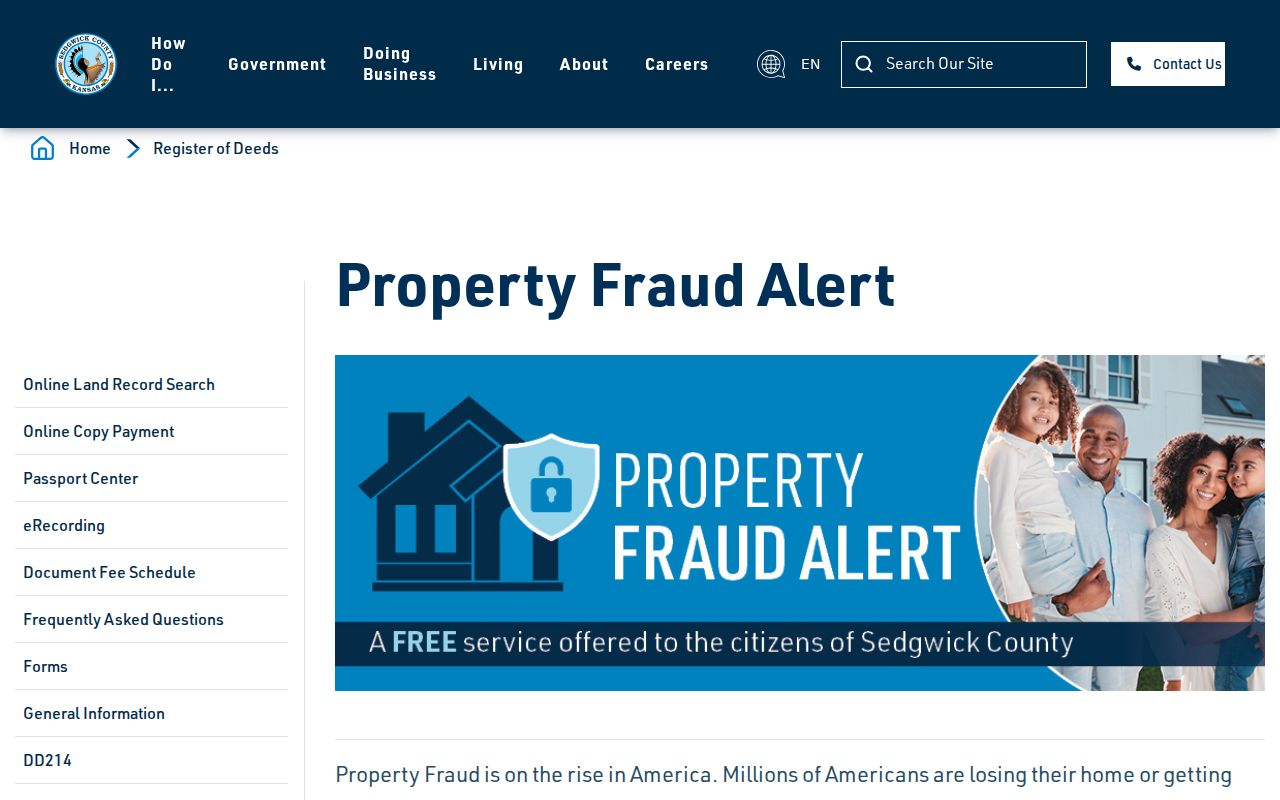
When a fraud alert flags the property, pull the recorded deed image and call the Register of Deeds about it. The alert is only a warning; it cannot stop a filing, cancel an instrument, or stand in for legal review of the deed records.
Other Sedgwick Recorded Instruments
The Register of Deeds holds far more than deeds. The office also preserves plats of additions, mortgages, releases and satisfactions, federal and state tax liens, oil-and-gas papers, powers of attorney, and UCC financing statements tied to real estate. Each filing adds a piece to the title trail. Still, not every instrument in the property records is a transfer, so read each one in context.
Plats tie a deed's lot and block to the recorded subdivision map. A mortgage release proves a lien was satisfied later. A power of attorney can explain why someone signed for an owner of record. Some material stays closed, though. Military discharges are not open to the public, and sensitive identifiers in scanned documents may be redacted. When the right category is unclear, search the broad index first. Note the document type code. Then ask recorder staff before concluding anything.
Releases carry their own search codes. The official guide points to MISC.RMTG for releases. It suggests MISC.SMTG for satisfactions if the first code comes up empty. Plats take a different path. Type part of the addition name and pick the matching subdivision. Then narrow with lot, block, or reserve codes. Rural instruments can be located by section, township, range, and quarter section. The guide warns that quarter-quarter selections sometimes return bad results. So the recorded legal description must remain the final check.
Oil-and-gas instruments, tax liens, and real-estate UCC filings can explain claims that never resemble a standard mortgage. Their appearance in the deed records says nothing about whether an obligation still stands. Search instead for a later release, satisfaction, or assignment. Then compare document numbers, dates, parties, and legal descriptions. The portal does not automatically supply prior deeds in a chain. The searcher must build and check each link.
Order a Sedgwick Deed Copy
A plain image opens straight from the blue document-number link in an online result. Printed copies at the public computer cost $1 per page. Want a clean, non-watermarked image or an official copy? Contact the Register of Deeds at 100 N. Broadway, Suite 105, Wichita, or call 316-660-9400. Give the document number when you have it. Otherwise supply party names, the recording period, and the legal description.
Mail and office requests still matter. They help when an image is missing or the deed predates the online index. A KORA request can reach county records outside routine access. But it cannot open closed material. For wider lookup mechanics, take the Sedgwick County property search route before ordering the deed.
Older instruments need a fuller request. Include the address or full legal description. Add likely party names and the last known transfer date. Recorder staff can search the grantor and grantee books. They can pull the microfilm or book-and-page reference. The County Clerk's historical transfer books offer a second path for pre-1992 ownership sequences. The Clerk does not hold the deed image, though. Kansas Historical Society land-record resources and the Sedgwick County archives can carry research beyond the local online collection.
Recorded, not guaranteed. Sedgwick County deed records show filed instruments. Unrecorded interests may exist, and the index is not a title opinion.