
The Values on a Sedgwick County Property Record
The Property Tax and Appraisal Information application holds the appraisal and assessment fields, while deed records and sales data add the transaction context around them. Read the value label before comparing numbers.
| Value | What It Is | Where |
|---|---|---|
| Assessed value | Appraised value multiplied by the Kansas class rate | Appraisal and tax record |
| Market / appraised value | County fair-market estimate for taxation | Appraiser parcel record |
| Last sale price | Consideration tied to a dated transfer | Deed and sales workflow |
| Land vs improvement | Modeled split between site and buildings | Appraiser parcel card |
The appraised figure is a mass estimate. Assessed value is a statutory tax base, and a sale price is one dated transaction, so a current market opinion requires property-specific analysis.
Calculate Sedgwick County Assessed Value
Kansas residential property is assessed at 11.5% of appraised value. That rate is not universal. Commercial and industrial land and improvements use 25%, vacant lots 12%, agricultural land 30% of use value, and qualifying not-for-profit property 12%. Know the classification before comparing anything.
- Appraised value
- The Appraiser's fair-market estimate.
- Assessed value
- The class-rate share used as the tax base.
- Assessment ratio
- The statutory percentage assigned to a property class.
- Sale consideration
- The amount reported with a transfer, subject to validation.
- Reassessment
- The annual process establishing a January 1 value.
Read Sedgwick County's January 1 Value Date
Real property is valued as of January 1. Notices mail March 1, and values are certified June 1. A later renovation or autumn market shift may not be reflected in that year's value.
The tax application warns that appraisal and tax data update at different times and may show different years. Record the year beside every number.
Note: A current screen can mix tax years, so compare field labels and effective dates before comparing property values.
Looking Up a Sedgwick County Property Value
Search the correct parcel first. Then separate its value components and compare sources without substituting tax due for property value.
- Search by address, owner, or parcel identifier.
- Confirm the AIN and legal description.
- Read land, improvement, appraised, assessed, and prior-year fields separately.
- Check the latest recorded transfer for sale context.
- Use comparable sales as model evidence, not a private appraisal.
- Assessed value
- The statutory tax base.
- Market / appraised value
- The county's full-value estimate.
- Level of assessment
- The ratio between assessed and appraised value.
Inspect Sedgwick County Comparable Sales
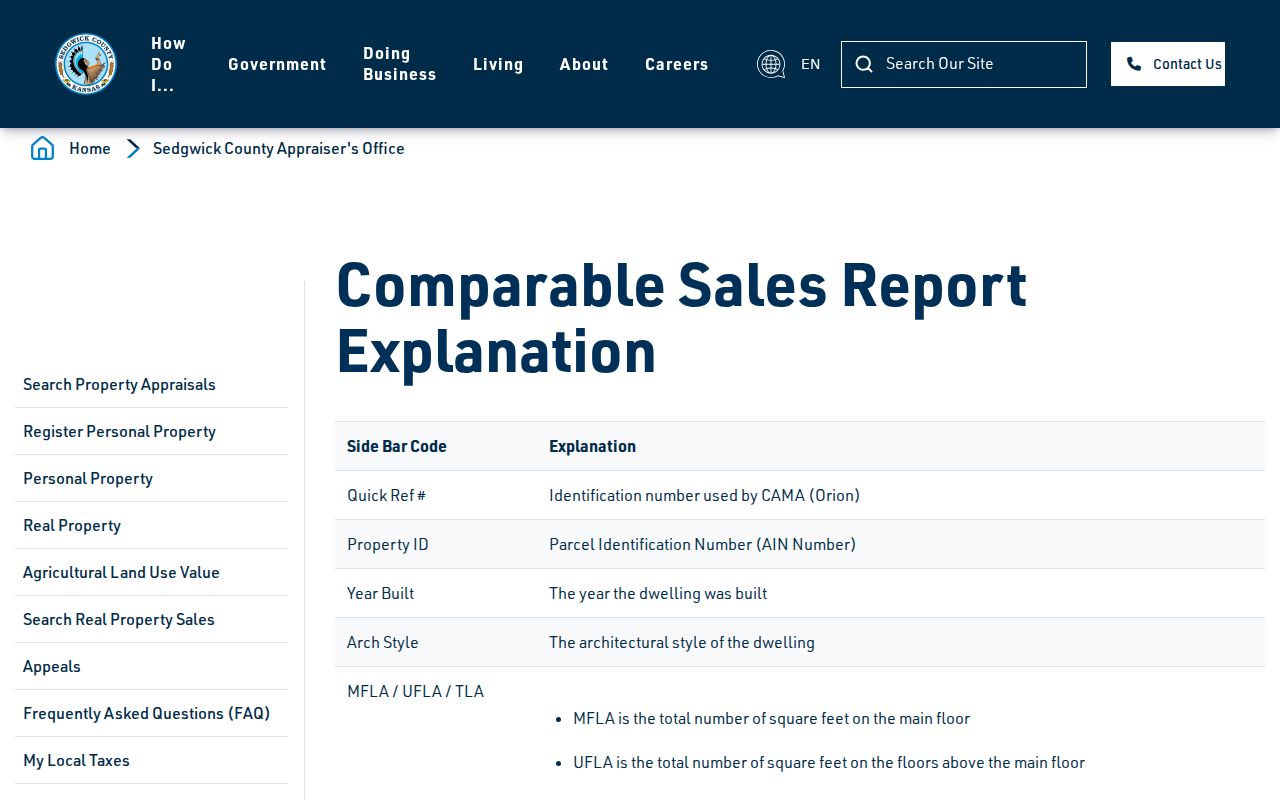
The Comparable Sales Report guide defines the AIN, building facts, sale price, comparison scores, and adjustments. The 2026 report narrows the field. Its standardized rules typically select five sales within an 18-month window, then apply time and feature adjustments. The official document spells out every term itself.
Comparison scores show the model's evidence. They cannot guarantee a sale price, especially for a unique property with weaker matches.
Understand Sedgwick County's 2026 Model
The 2026 cycle uses a January 1 date. Sales run from July 1, 2024 through December 31, 2025. Its report describes a uniform 95% override. The override applies to the better cost or market estimate for improved residential property. Keep that method with the 2026 figure only. Do not project it onto another year without that year's report.
Locate Sedgwick County Sale-Price Context
The Register of Deeds records the deed. The Clerk transfers that data into the tax workflow. The Appraiser validates the sale. The sales-validation questionnaire is restricted. A public deed result therefore does not expose every analysis field.
Use the land-record search to match the newest deed's legal description. Treat its consideration as one dated observation, especially when the transfer was not arm's length.
Separate Sedgwick County Land and Improvements
A parcel card can divide value between land and improvements. The split shows how the model allocates the total. Neither piece could necessarily be sold alone. Inspection codes may reflect permits, field checks, sales verification, and split or combination review, so such maintenance explains a record change without being a sale.
Note: A deed transfer may be newer than appraisal fields because county interfaces do not guarantee an immediate public update.
Verify Sedgwick County Value Records Offline
The Appraiser's office sits at 271 W. 3rd St. N., Suite 501, Wichita. Call 316-660-9261. Staff can help when the portal is unavailable or the value year is unclear. The office maintains parcel characteristics, appraised and assessed values, and value notices. It does not set levies or collect the bill.
A KORA request can seek an existing public appraisal record not exposed online. Sedgwick County normally answers within three business days. That initial response provides access, states timing and cost, or explains a denial. Ask for the specific parcel, year, and existing field or document rather than asking staff to create a new valuation analysis.
What a Sedgwick County Assessor Value Is Not
Assessed value exists for taxation. It is not a private appraisal. Nor is it an offer or a guaranteed sale result. It is not a title opinion either. A mass model can miss things. Condition, unusual design, restrictions, or changes after January 1 may all escape it. Exemptions may also alter the taxable result without touching the underlying estimate. Tax bills, exemptions, and appeals belong in the property tax records guide.
Value vs price. Sedgwick County assessed value is a tax calculation, not what the property will necessarily sell for and not a private appraisal.
Compare value evidence on the same date. The comparison should also cover the same property interest. A recorded sale may bundle multiple parcels, personal property, or a non-arm's-length transfer. The tax card assigns a value to one AIN for a particular appraisal year instead. Building changes, classification shifts, and parcel combinations can make a year-to-year percentage misleading.
Keep the parcel card, value notice, comparable-sales detail, and deed reference as separate records. Label each one. Put the AIN and tax year on every saved item so values from similarly addressed parcels stay untangled. The Appraiser can explain its roll and appeal process. A private appraiser can offer an independent opinion. That distinction matters. Neither the Treasurer's amount due nor an online estimate fills it.