
Sedgwick County Tax Record Fields
No single desk builds a Sedgwick County tax account. Value and parcel facts come from the Appraiser. Levy and transfer work sits with the Clerk. The Treasurer holds billing and payment data. That division explains why two screens can seem to disagree. Sedgwick County itself cautions that appraisal data and tax data update on different schedules. They may even describe different tax years. A mismatch is often timing rather than error.
| Record field | Meaning in the account | Official source |
|---|---|---|
| Appraised value | Fair-market estimate set for taxation | Sedgwick County Appraiser |
| Assessed value | Class-rate share used in the tax formula | Sedgwick County Appraiser |
| Parcel and legal facts | Identifier, legal description, lot size and characteristics | Appraiser and County Tax System |
| Bill and specials | Taxes billed, due and special assessments | Sedgwick County Treasurer |
| Payment history | Prior payments and open balances | Sedgwick County Treasurer |
Each number answers a different question. An appraised value is not a sale price. The assessed value is the class-adjusted figure that levies actually apply to, and the bill then adds those levies plus any specials tied to the account. For a fuller breakdown of these figures, see the Sedgwick County property value explanation.
Three Sedgwick County Tax Roles
Three offices divide the tax work. The Sedgwick County Appraiser values real estate and maintains parcel characteristics. It sets no mill levy and collects no bill. The County Clerk records transfers for tax purposes. The Clerk also keeps taxpayer mailing addresses current, prepares the roll, and manages levy records. The Sedgwick County Treasurer issues statements, takes payments, and tracks delinquency and payment history.
County Appraiser
271 W. 3rd St. N., Suite 501, Wichita
316-660-9261
Monday through Friday, 8 a.m. to 5 p.m.
County Clerk
100 N. Broadway, Suite 620, Wichita
316-660-9223
Transfer, roll, mailing and levy records
County Treasurer
100 N. Broadway, Suite 100, Wichita
316-660-9127
Bills, specials, payments and delinquencies
Match the office to the problem. A value dispute belongs with the Appraiser. A wrong or missing mailing address points to the Clerk. Payment, duplicate statement, payoff, and delinquency questions all go to the Treasurer.
Search Sedgwick County Property Tax
The Property Tax and Appraisal Information application is the shared public entry point. It asks users to accept a state-law certification before any search runs. Documented search modes include owner name, property address, address range, and parcel identifier. An address may pull up more than one unit or lot. Pick the record by its legal description or AIN.
| Search choice | Best use | Result clue |
|---|---|---|
| Property address | One known street location | Match situs and legal description |
| Address range | A short street segment | Review each parcel, not just the first hit |
| Owner name | Parcels tied to a tax-roll name | Check spelling and entity form |
| PIN, GeoCode or AIN | An exact known parcel | Most stable cross-record key |
A result can display the legal description, owner and mailing address, identifier codes, lot size, current and past values, property facts, and billing detail. Appraisal detail sits apart from taxes billed, due, and paid. The official portal page shows that entry point along with the required disclaimer. Open the Sedgwick County tax and appraisal application before running an address or parcel search.
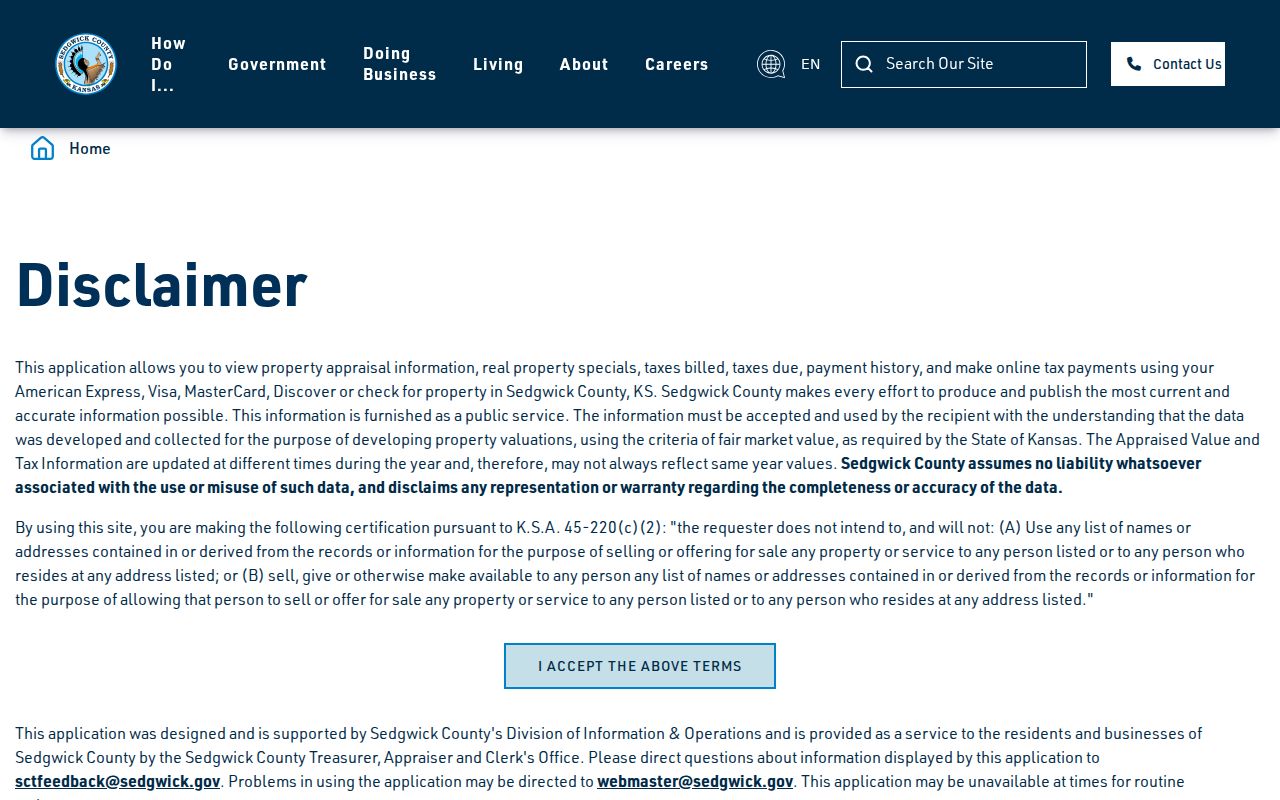
One shared screen can show both assessment facts and Treasurer billing data. That convenience does not merge the two records, and reading them as one can mislead.
Trace a Sedgwick County Tax Bill
Keep the parcel key in view from start to finish. Street names repeat across Sedgwick County, and one parcel may carry several addresses or units. The AIN, PIN, GeoCode, and legal description give a firmer match than any address alone. Check the current bill and the payment history together. A posted payment, an unpaid special, or a prior-year balance can change what the record really says about taxes owed.
- Accept the county portal certification, then search the exact address. Use the address-range mode only if the exact form fails.
- Open the matching parcel and record its AIN plus legal description. Confirm that the situs is the land being researched.
- Read the appraisal year, appraised value, assessed value, specials, taxes billed, taxes due, and payment history as separate fields.
- If a balance or payment seems wrong, contact the Treasurer. Request a duplicate statement by 316-660-9000 or treasurer@sedgwick.gov when needed.
- Appraised value
- The Appraiser's fair-market estimate for tax purposes.
- Assessed value
- The taxable share after the Kansas property class rate is applied.
- Mill levy
- The combined tax rate applied to assessed value.
- Special assessment
- A charge tied to a specific improvement or district.
- Tax lien
- A claim against land for unpaid property tax.
Payment timing is simple. Full or first-half tax falls due December 20, and the second half comes due May 10. Those deadlines govern payment only and have no bearing on the earlier value-notice and appeal cycle.
Sedgwick County's Tax-Year Clock
Sedgwick County's tax year runs on a fixed clock. Appraisal starts from a January 1 valuation date. Real-property value notices go out March 1, and an informal equalization appeal is due within 30 days of mailing, which usually lands on March 31. The Appraiser certifies values June 1. The Clerk certifies the roll to the Treasurer November 1, and statements mail December 15. The official Appraiser tax calendar lays out those steps and keeps value review separate from payment under protest, a later path tied to the bill itself.
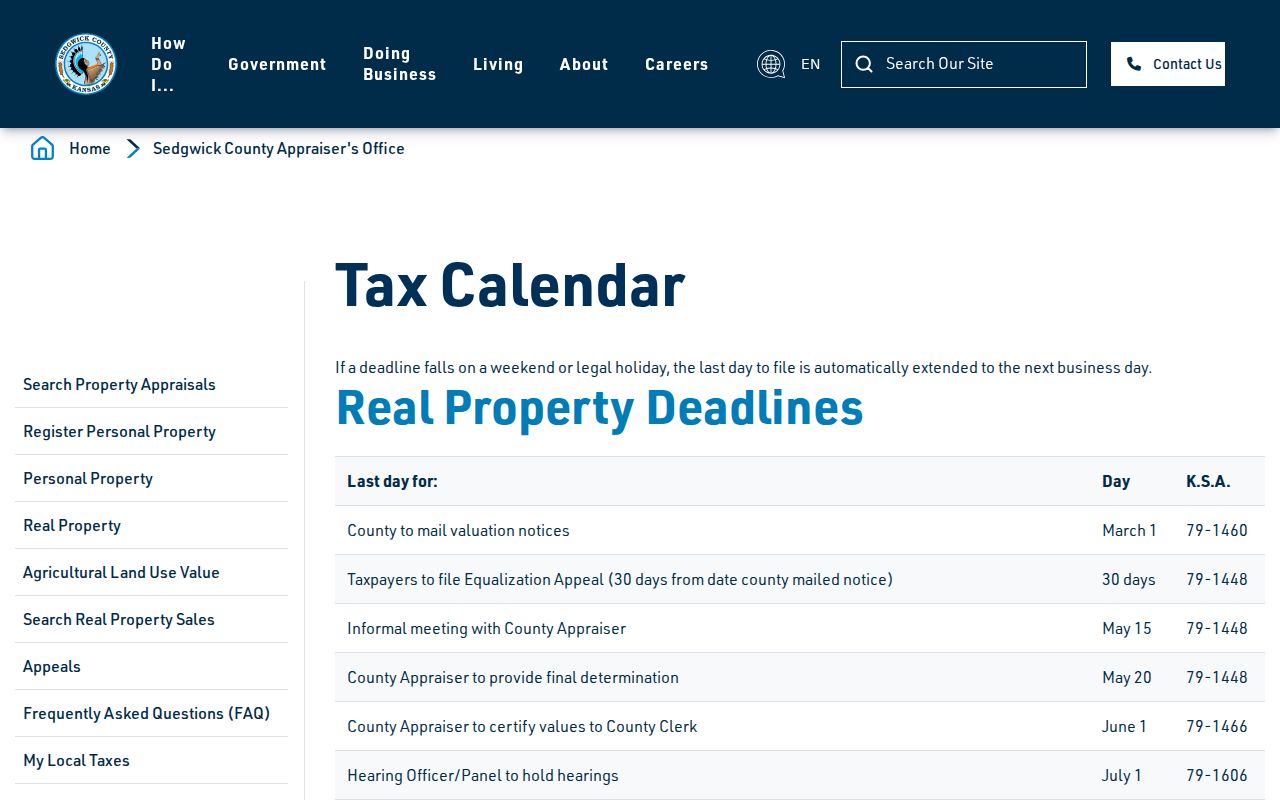
Knowing the calendar lets a Sedgwick County owner question a March value notice in March. Waiting for the December statement usually means working the wrong record at the wrong stage.
Note: A mailed value notice and a year-end tax statement trigger different review routes and should not be treated as the same document.
Sedgwick County Assessment Math
Kansas classifies property before the levy is applied. Residential property uses 11.5 percent of appraised value. Commercial and industrial real property uses 25 percent, vacant lots use 12 percent, and agricultural land is assessed at 30 percent of use value rather than simple market value. The assessed figure is thus not a second market estimate.
For a residential example, an appraised value of $200,000 produces $23,000 in assessed value before levies and applicable adjustments. This illustrates the rate only; it does not state the parcel's bill. The final amount depends on the levies and districts tied to that parcel, plus specials and credits shown in the Sedgwick County property tax records.
The 2026 mass-appraisal report adds local context. Sedgwick County used a January 1 valuation date and sales from July 1, 2024 through December 31, 2025 for the sales approach. For improved homes, the report describes a uniform 95 percent override of the better cost or market estimate. That modeling rule belongs to the valuation record, not the payment ledger, and should be read with the current notice.
Keep the figures apart. Appraised value estimates market value for taxation; assessed value applies the Kansas class rate; the Treasurer's bill applies levies.
Contest a Sedgwick County Value
A property owner who disagrees with a value notice can start with an informal appeal. The window is short. Sedgwick County allows 30 days from the mailing date to file. Evidence should speak to the property itself and the valuation date. So bring factual errors in size, condition, class, features, or relevant sales rather than general complaints about the tax bill. Filing locally costs nothing. The Appraiser reviews the record and issues a decision on the annual schedule.
The Sedgwick County appeals page also lays out payment under protest. It covers the Board of Tax Appeals small-claims route too. Payment under protest is not a second bite at the same valuation appeal. It cannot repeat one within a single tax year. Choose the route that matches where the case stands.
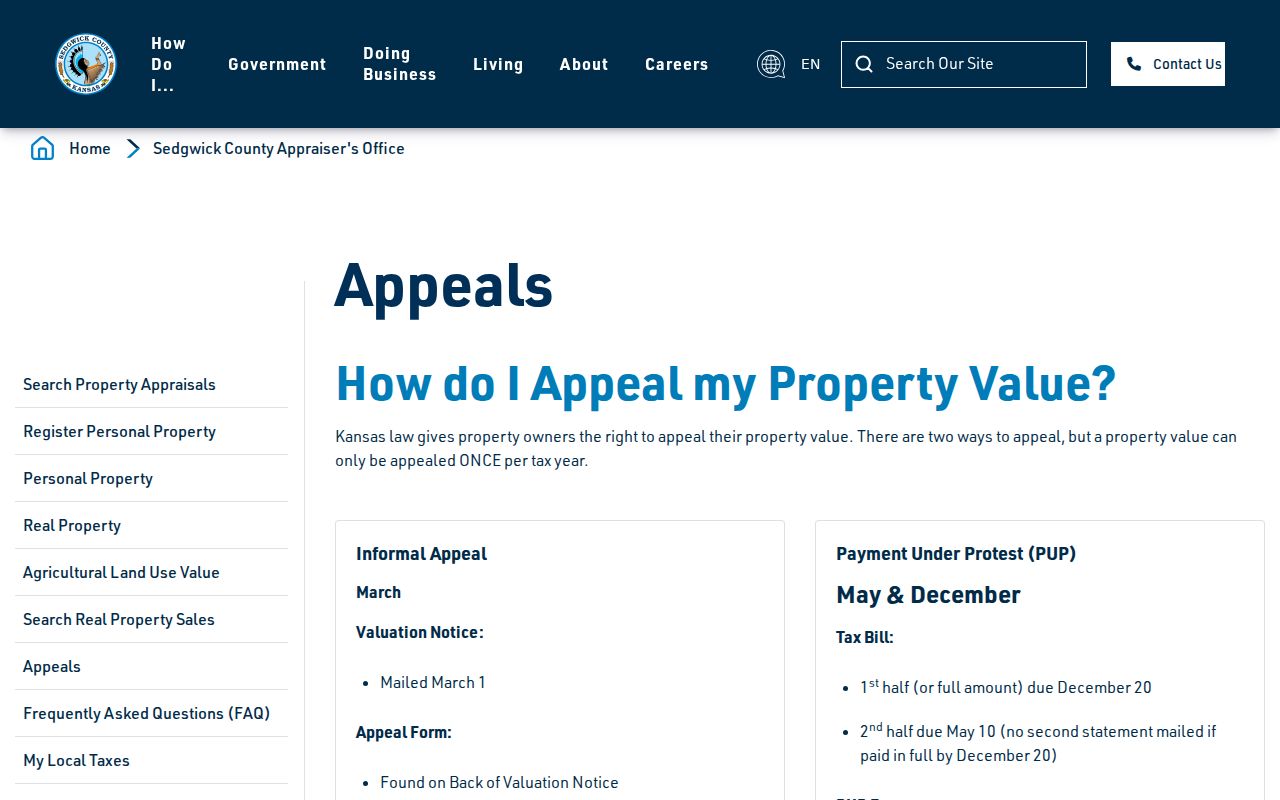
Sedgwick County gives owners two separate paths to fight a value. The first is an early, informal equalization appeal; the second is a later protest tied to paying the tax, so pick the right one before a deadline closes.
Appeal deadline. File within 30 days of the value notice, commonly by March 31; confirm the date printed on the current notice.
Sedgwick County Tax Relief Records
Relief in Kansas turns on program rules. It also turns on income, age, disability, veteran status, and ownership or occupancy facts. A tax account may show exemption or classification coding. But that display never decides a refund. The County Clerk routes property-tax-relief questions and handles mailing-address updates for taxpayers.
Keep two addresses straight. The situs is where the land sits. The mailing address is where the tax notice travels, and it can lie outside Sedgwick County. A stale address explains a missed statement. It does not erase the tax or move an appeal deadline.
Sedgwick County Delinquency Trails
Unpaid property tax starts with the Treasurer's delinquency search. Check the parcel key, the amount due, and the payment history. A delinquent account alone does not prove an auction has been scheduled. An old display is not a payoff quote either.
Later stages surface elsewhere. Look to the Treasurer's tax-foreclosure cases and the court file. Then check the sale notice. Finally, review any recorded sheriff deed. In 2026 the county posted tax-foreclosure case exhibits and a mapping application. It noted that no auction date had been set. That distinction matters. A listed case is not a scheduled sale.
For a live transaction, get the exact current amount and status from the Treasurer. A foreclosure case may have moved past the tax account. Court and recorded-instrument checks may also be needed.