
Identify a Sedgwick County Property Owner
Two county records answer most ownership questions. The Appraiser's tax system carries the current owner-of-record name tied to the parcel. The Register of Deeds holds the recorded instrument naming the grantee who took the interest. Match the parcel number and legal description across both offices. That match completes the core method.
- Search the street address in Property Tax and Appraisal Information. Select the parcel whose situs and legal description match.
- Write down the Property Owner, mailing address, AIN or other parcel key, and full legal description.
- Search the Register of Deeds land records for the newest deed naming that owner as grantee. Compare its legal description.
- If the names or dates conflict, ask the Register of Deeds about the latest recorded instrument rather than assuming the tax roll has refreshed.
A search like this returns the public record owner, not the person living in the house. The two are often different. A Sedgwick County tax roll may list an out-of-state mailing address, and a trust or business name can stand in for an individual, so the name you find is simply who holds legal title.
Sedgwick County Ownership Record Sources
Sedgwick County has several official sources. Each one answers a different piece of the ownership question. The tax roll is the simplest starting point when all you have is an address. The deed shows the recorded transfer of title. A GIS map helps you pick out the right parcel. It stands in for neither of the other records. When the owner of record turns out to be a company, a business filing may explain the entity name. Even so, it cannot prove what that entity owns.
| Where ownership appears | What it gives | How current |
|---|---|---|
| Appraiser tax roll | Property Owner, mailing address, situs, parcel key and legal description | Current roll, with variable transfer lag |
| Register of Deeds | Grantee, grantor, recording reference and deed image | Newest recorded instrument controls the comparison |
| Mobile Land Records | Selected parcel, property popup, report, tax and plat links | GIS and tax data update on agency schedules |
| Kansas business search | Entity filings, status and resident-agent details | Current filed business record |
An owner name on any single screen is a clue, not a conclusion. Joint owners, life estates, transfer-on-death deeds, and trust language all hide in the fine print. Reading the full recorded instrument settles those questions.
The County Clerk sits between the filing and the tax-roll display. It records each transfer for tax purposes and maintains taxpayer mailing addresses. Its online transfer system covers recent Sedgwick County records. But the office notes that pre-1992 history lives most accurately in the historical transfer books. That system traces the pipeline from deed to tax roll. It still does not replace the deed image itself.
Sedgwick County's Property Owner Field
Sedgwick County labels its tax-roll field "Property Owner" or simply "Owner." The GIS layer adds aliases like Owner, Owner_madd, Owner_City, Owner_Stat, and Owner_zip. Separate situs fields, Prop_Addr, Prop_City, and Prop_zip, describe the parcel itself. Keeping the mailing group and the situs group apart prevents a common mistake. Where the tax bill goes and where the property sits are different facts. They track who owns and who occupies.
The official record description notes that a parcel result can carry the legal description, property owner, mailing address, identifier codes, lot size, current and prior values, characteristics, and billing detail. Those details are useful for confirming the right parcel was pulled. They still do not add up to a certified title report.
Open the official county disclaimer and property search entry to reach the tax-roll owner field directly.
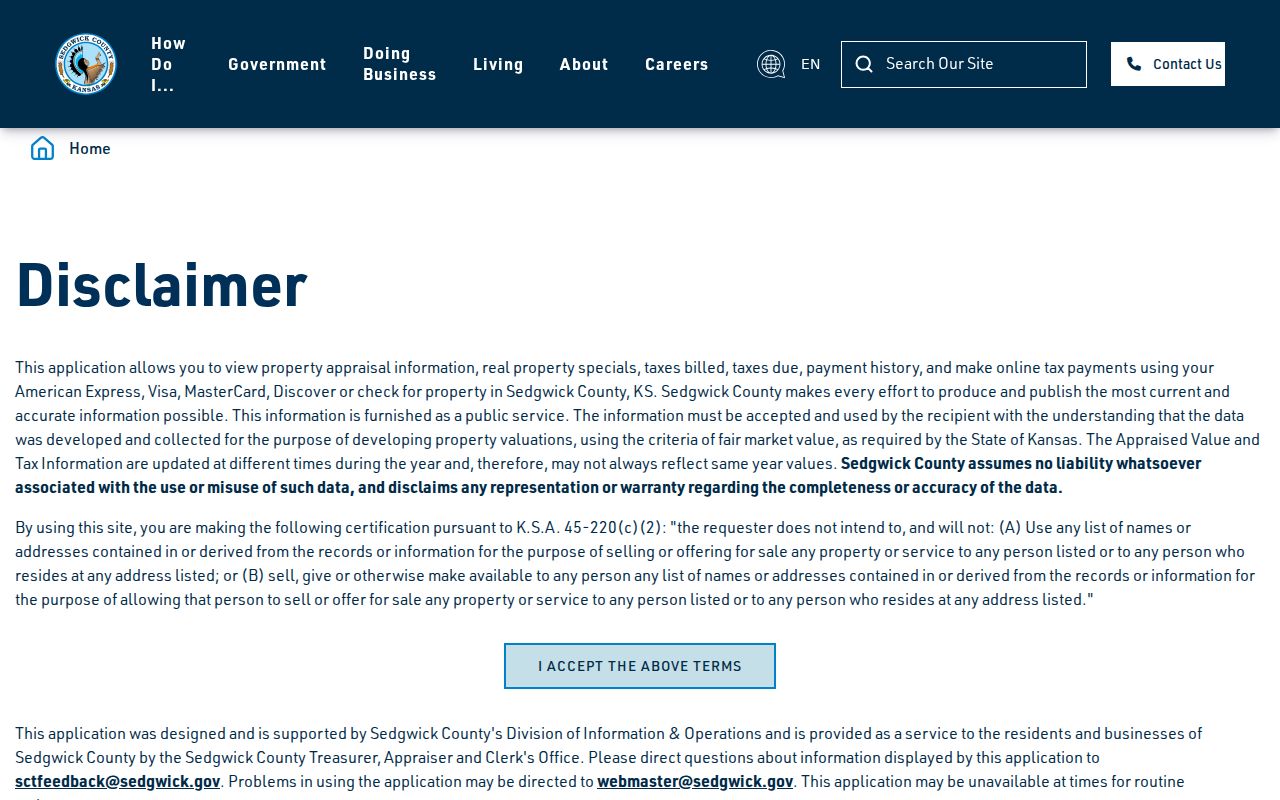
A certification message appears before the search begins. Sedgwick County is reminding users that public owner data must stay within Kansas limits on lists of names and addresses.
Confirm the Sedgwick County Owner
A recent sale can hit the deed index first. The Appraiser's public owner field lags behind. Sedgwick County runs nightly interfaces that feed transfer deed data into the appraisal workflow. But nothing is guaranteed overnight. The delay varies.
Search the likely owner as grantee within a narrow date range. The recorder's guide codes grantor as GTOR and grantee as GTEE. Individuals appear as LAST FIRST MI. Open the newest deed result and match its legal description to the tax parcel. The blue document number opens the image where one exists.
The Sedgwick County deed index reaches back to 1945, and other instruments to 1969. Most ownership checks fall inside that span. When a transaction is too new, unclear, or missing, call the Register of Deeds at 316-660-9400 or use the public computers at 100 N. Broadway, Suite 105 in Wichita.
Sedgwick County Owner Terms
Who owns a house often turns on small wording. The assessor, the recorder, and the GIS map do not use every term in the same legal sense, so define the words before comparing records.
- Owner of record
- The name currently carried on the county tax roll for the parcel.
- Grantee
- The person or entity receiving the interest in a recorded deed.
- Title
- The legal ownership interest, which cannot be proved by a tax-roll name alone.
- Situs address
- The physical place of the parcel or improvement.
- Mailing address
- The place where the county sends tax notices.
One person may be a grantee alongside a joint owner. A trustee can hold title under trust terms. A life tenant may hold present rights while another party keeps a future interest. Only the deed itself reveals that form of ownership.
Vesting describes how an ownership interest is held and stated in an instrument. The index name just finds the deed. Its granting language and full legal description show more. When rights are disputed, the public index is a lead. It is not the final word for legal review.
Trace Sedgwick County Entity Owners
Sometimes the tax parcel names no person at all. The owner of record may be an LLC, a corporation, a trust, an estate, or a trustee acting for one. Start with the exact name shown on the tax roll. Then work spelling and abbreviation variants through the deed index. The same party often appears under a trustee name, a trust name, or a shortened entity form.
Entities need one extra step. The Kansas Secretary of State Business Entity Search takes a business name, a Kansas Business ID, or a resident-agent name. It returns up to the first 200 matches. The state ID is not a federal employer number. A filing there can pin down the legal entity and its filed agent. But the agent is not automatically the property owner.
Estates raise their own wrinkles. Ownership can sit under the decedent's name, an estate label, or a personal representative during a probate or tax cycle. Court probate records explain who holds authority. The later deed shows the recorded transfer. Resist forcing a simple person-to-person answer. The property records may point to an entity or an estate instead.
Sedgwick County Owner Name Alerts
The Register of Deeds runs a free Property Fraud Alert. You enter names, and the office sends a notice whenever a possible match gets recorded. An alert may carry the document number, the document type, and the recording date, which gives an owner of record a prompt to pull the filing and inspect it.
A match is not a county finding of fraud. Common names generate plenty of chance hits. The office suggests registering multiple spellings and offers special entry tips for businesses and trusts, including leaving corporate designations out of business alert names. When a notice looks wrong, open the deed image and contact the recorder. The key point for a who-owns-this-property search is simple. The alert watches a name, not a parcel, and it can neither certify title nor block a recording on its own.
Offline Sedgwick County Owner Checks
Portals are not the only door. The Register of Deeds keeps free public computers at the Ruffin Building. Printed pages cost $1 each. Tapestry EON offers remote pay-per-search access at $8.75, while Laredo serves subscribers. For tax-roll questions, the Appraiser handles parcel and owner-field issues at 271 W. 3rd St. N., Suite 501 or 316-660-9261.
Sometimes a county record is not exposed in any portal. A Kansas Open Records Act request can identify the document that exists. Sedgwick County accepts requests online or by email. It normally sends an initial response within three business days. Search, staff, reproduction, and delivery charges may apply. A request can seek existing records. It cannot force staff to build a new owner report.
Note: For a live purchase or disputed interest, a Kansas title professional can examine rights and encumbrances beyond the public owner name.
Limits on Sedgwick County Owner Lookups
A public owner record has firm boundaries. It does not say who lives at the property, who may visit, or who holds a private agreement concerning it. It can even display a protected or substitute address. Under Kansas Safe at Home, qualifying victims and household members may use a substitute address that covered government offices must accept.
State law also limits commercial reuse. K.S.A. 45-230 bars using names and addresses drawn from public records to sell or offer property or services, and the county tax application requires a related certification under K.S.A. 45-220(c)(2). Sensitive numbers in recorded documents may be redacted. Military discharges stay closed to general public inspection.
Record name, not title proof. Use owner data for lawful property research only; never use it to stalk, harass, threaten, or target a person.
For present-roll detail, the Sedgwick County current owner record walks through comparing its fields. A title search remains the right tool for settling legal ownership and encumbrances.